
Postpartum Psychosis: Signs, Risks and Urgent Help


Postpartum Psychosis Is a Medical Emergency. Here Is What Families Need to Know
What the Lindsay Clancy case and recent reporting reveal about a condition too many families learn about only after a crisis.
Important: If you believe someone is experiencing hallucinations, delusions, severe confusion, or a sudden loss of contact with reality after giving birth, seek emergency medical care now. Call 911 or your local emergency services, or go to the nearest emergency department. Do not leave the person alone with the baby while you wait for help.
Most people first hear the words postpartum psychosis in the worst possible way: in a headline, after something devastating has already happened.
That is part of why we recently joined The Prosecutors podcast to talk about postpartum psychosis through the lens of the Lindsay Clancy case. We were not there to diagnose Lindsay Clancy from a distance or to answer the legal questions in her case. A diagnosis and a finding of legal responsibility are not the same thing, and neither can be decided from news reports.
But this case does raise a larger question. Why are so many families learning about postpartum psychosis only after a crisis?
What is postpartum psychosis?
Postpartum psychosis is a uncommon but severe psychiatric condition that affects approximately 1 to 2 people per 1,000 births. It usually begins suddenly, most often within the first days or weeks after delivery, although it can begin later. It is considered a psychiatric emergency because judgment and contact with reality can become impaired very quickly, creating a risk to the parent, the baby, or both (VanderKruik et al., 2017; Friedman et al., 2023).
Despite its name, postpartum psychosis is not simply postpartum depression that has become more intense. It often occurs alongside symptoms of mania, depression, or a mixed mood episode, particularly in people with bipolar I disorder. It is also not the baby blues, ordinary new-parent exhaustion, a failure to cope, or a reflection of how much someone loves their baby.
Symptoms can change over the course of a day. Someone may sound more organized during a brief appointment and become markedly confused or agitated again later. That fluctuation is one reason family observations matter and why a reassuring ten-minute conversation should not automatically override a dramatic change witnessed at home (American College of Obstetricians and Gynecologists [ACOG], 2023).
Early signs families should know
Postpartum psychosis can look different from person to person, but possible warning signs include:
- Being unable to sleep or sleeping very little, even when someone else is caring for the baby
- Appearing unusually energized despite little or no sleep
- A sudden surge in agitation, irritability, restlessness, or rapid speech
- Extreme or fast-moving shifts in mood
- Confusion, disorientation, or difficulty following a conversation
- Behaviour that is disorganized, impulsive, or strikingly unlike the person’s usual behaviour
- Paranoia or intense suspicion of loved ones, clinicians, or others
- Fixed beliefs that are not based in reality, which are called delusions
- Hearing or seeing things that other people do not, which are called hallucinations
- An unusual sense of having a special mission, extraordinary power, or a message from God or another source
- A sudden loss of insight, meaning the person does not recognize that they are unwell
Sleep deserves particular attention. Almost every new parent is tired. What raises more concern is a person who cannot sleep at all, needs dramatically less sleep than usual, remains highly activated despite sleep loss, or becomes increasingly confused and unlike themselves. Sleep disruption can be an early symptom, an aggravating factor, or both. It should not be dismissed as simply part of having a newborn.
Who is at greater risk?
The strongest known risk factors include a personal history of postpartum psychosis, bipolar I disorder, or a family history of bipolar disorder or postpartum psychosis. People with a known history need specialist planning during pregnancy, not a rushed conversation after the baby arrives. Current guidelines recommend coordinated prenatal planning that includes psychiatry, the obstetric or primary care team, family or other support people, medication planning, observation, and strategies to protect sleep (ACOG, 2023; Vigod et al., 2025).
At the same time, a lack of psychiatric history does not rule postpartum psychosis out. Many people admitted with postpartum psychosis have no previously documented psychiatric diagnosis. This is why education cannot be reserved only for families already considered high risk.
Is postpartum psychosis actually increasing?
The answer is concerning, but more nuanced than a headline can hold.
A national study examined more than 12.3 million U.S. deliveries from 2016 to 2019. Diagnoses recorded during delivery hospitalizations and postpartum readmissions both rose over that period, but only the increase in readmissions was statistically significant. The researchers also cautioned that administrative data cannot tell us whether the underlying illness itself became more common. Better recognition, changes in screening, diagnostic coding, or access to care could explain part of the increase (Albers et al., 2023).
The 6 percent figure described by the psychiatrist came from her own clinical caseload during an eight-week period. That is important as a frontline warning, but it should not be interpreted to mean that 6 percent of all postpartum people develop psychosis. A specialist clinic sees a much higher-risk group than the general population.
In other words, the data support taking the trend seriously, but they do not yet tell us exactly why diagnoses are rising.
Intrusive thoughts are not automatically psychosis
This distinction matters because many parents experience frightening, unwanted thoughts after having a baby and then become terrified that the thoughts mean they are dangerous.
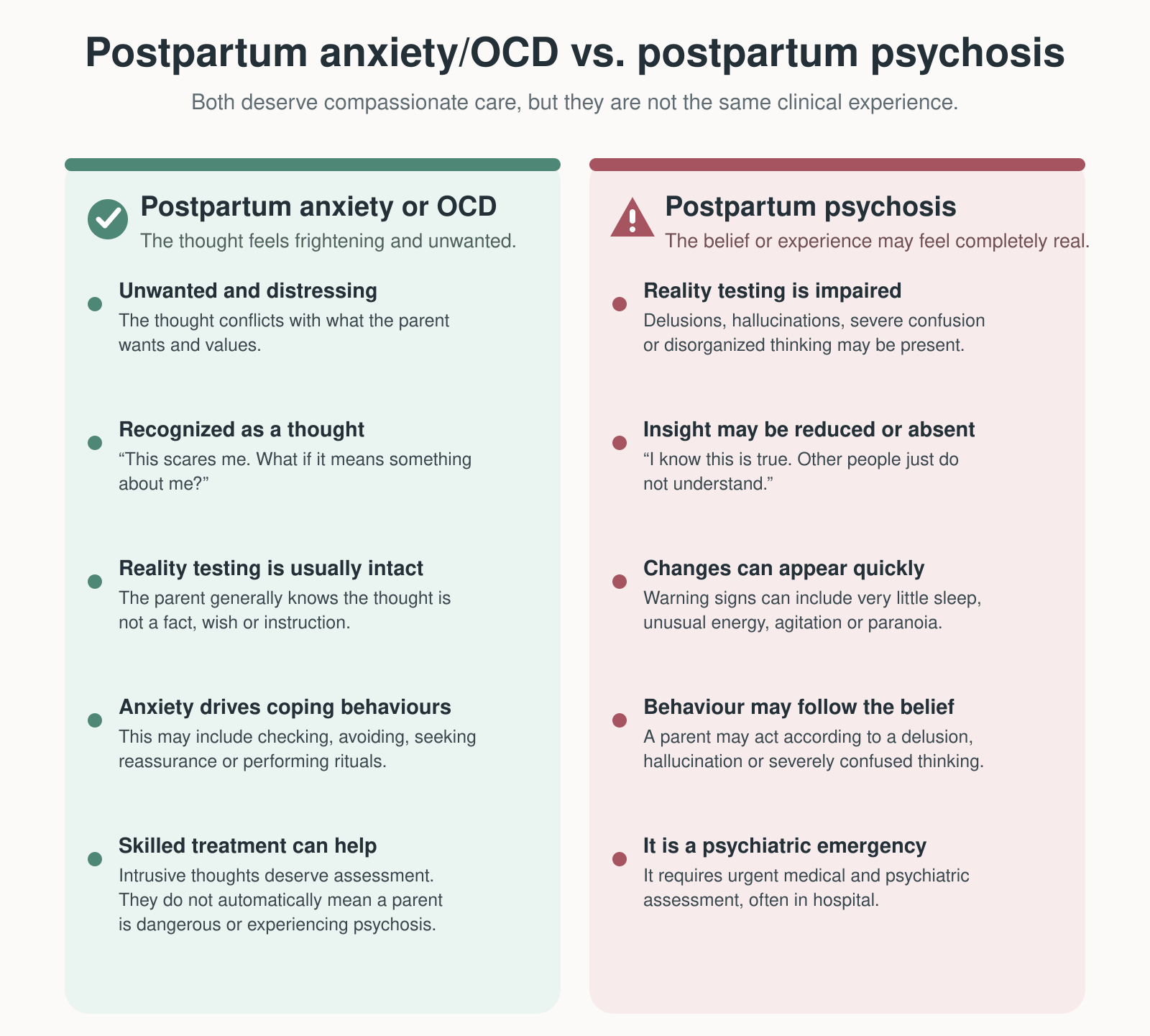
Intrusive thoughts still deserve skilled assessment and treatment, but their presence alone does not mean someone has postpartum psychosis. A clinician trained in perinatal mental health should know how to ask about the content of the thought, how the person understands it, whether it feels wanted or true, whether reality testing is intact, and whether there is intent or a plan (Hudepohl et al., 2022).
What should a family do if they see these signs?
Treat a sudden break from reality after childbirth as an emergency.
Do not wait for the next therapy appointment or assume the person will sleep it off. Contact emergency services or go to an emergency department. Stay with the person, have another trusted adult care for the baby, and share specific observations with the medical team. It is more useful to say, “She has slept about two hours in three days, says the television is sending her instructions, and tried to leave the house barefoot,” than to say only, “She is not herself.”
Avoid arguing at length about whether a delusion is true. Speak calmly, reduce stimulation when possible, and focus on getting the person safely assessed. Because insight may be impaired, the person may resist help or insist that nothing is wrong. Their refusal does not make the situation less urgent.
Medical assessment is also important because infection, thyroid problems, medication effects, substance use, neurologic illness, and other medical conditions can sometimes cause or worsen psychotic or delirium-like symptoms.
Treatment works, but therapy alone is not emergency treatment
Postpartum psychosis usually requires psychiatric hospitalization, a full medical and psychiatric assessment, and medication. Depending on the clinical picture, treatment may include an antipsychotic, lithium, short-term medication for severe agitation or insomnia, and sometimes electroconvulsive therapy. Medication decisions during lactation require careful coordination among psychiatry, the prescribing medical team, pediatrics, and the family (ACOG, 2023; Jairaj et al., 2023; Vigod et al., 2025).
Many people recover, particularly when the condition is recognized and treated quickly. Recovery is not always immediate or tidy. After the acute symptoms settle, a parent may be left trying to make sense of memory gaps, hospitalization, separation from the baby, fear, shame, grief, or changes in how safe they feel in their own mind. Partners and other family members may also be shaken by what happened. This is where skilled psychotherapy can become an important part of longer-term recovery.
Why perinatal mental health training matters in a therapist
General mental health training is valuable, but the perinatal period has clinical features that can be missed when pregnancy and postpartum are treated as background details.
A therapist with adequate perinatal mental health training should be able to:
- Recognize the early signs of mania and psychosis, including severe sleep disruption, abrupt activation, confusion, and loss of insight
- Distinguish distressing intrusive thoughts from delusions or hallucinations
- Ask about bipolar disorder, previous postpartum episodes, family psychiatric history, medication changes, and sleep
- Include partners or other support people in prevention and emergency planning, with consent when appropriate
- Coordinate with family medicine, obstetrics, midwifery, psychiatry, and emergency services
- Know when outpatient therapy is no longer the appropriate level of care
- Support recovery after stabilization, including trauma, shame, identity, relationships, attachment, and planning for a future pregnancy
This is not about expecting a therapist to act as a psychiatrist or manage psychosis in an outpatient office. It is about expecting them to recognize the limits of therapy and respond decisively when the clinical picture changes. Postpartum psychosis is not a “let’s add another appointment this week” situation.
The concern is not theoretical. A Canadian study involving 435 perinatal service providers described major gaps in screening, coordinated care, provider knowledge, and access to specialized services. More than half of providers in the survey did not have specialized training in perinatal mental health. A more recent qualitative study of licensed therapists also found that many had received little formal perinatal training in graduate school, supervision, or continuing education (DeRoche et al., 2023; Rizan & Thomas, 2025).
No training can prevent every crisis. It can, however, make it more likely that an unusual symptom is taken seriously, the right questions are asked, and a family is directed to emergency or psychiatric care without a dangerous delay.
Questions to ask a prospective therapist
If you are pregnant, postpartum, or planning a pregnancy and have mental health concerns, it is reasonable to ask:
- What specific training have you completed in perinatal mental health?
- How do you assess for bipolar disorder, mania, psychosis, and perinatal OCD?
- What would you do if I developed symptoms that required urgent psychiatric care?
- Do you have referral relationships with physicians, psychiatrists, or other perinatal providers?
- How do you involve a partner or support person in planning, when appropriate?
A therapist should be able to answer these questions clearly. “I work with anxiety and depression” is not quite the same as having training in the full range of perinatal mental health conditions.
We need to talk about postpartum psychosis before the headline
The overwhelming majority of parents with mental illness do not harm their children. We should not talk about postpartum psychosis in a way that turns every affected mother into someone to fear. That kind of stigma can make people hide symptoms and make families hesitate to ask for help.
At the same time, avoiding the subject does not protect anyone.
Families deserve clear information before birth. High-risk patients deserve coordinated prevention plans. Clinicians need enough training to tell the difference between intrusive thoughts, depression, mania, and psychosis. When warning signs appear, families need a system that responds with urgency and care rather than disbelief.
We should not have to wait for a courtroom, a podcast, or an unthinkable loss to learn the words postpartum psychosis.
You can listen to our full conversation on The Prosecutors here
Looking for perinatal mental health support?
At Couples to Cradles Counselling, perinatal mental health is a clinical area of focus, not an afterthought. Our team supports clients with postpartum anxiety, depression, intrusive thoughts, birth trauma, identity changes, and other concerns during pregnancy and after birth. Book your free therapy consultation with our team here
Therapy is not an emergency service. If you or someone you know may be experiencing postpartum psychosis, contact emergency services or go to the nearest emergency department.
Selected literature
Albers, S. M., Wen, T., Monk, C., Logue, T. C., D’Alton, M. E., Booker, W. A., & Friedman, A. M. (2023). Postpartum psychosis during delivery hospitalizations and postpartum readmissions, 2016-2019. American Journal of Obstetrics & Gynecology MFM.
American College of Obstetricians and Gynecologists. (2023). Treatment and management of mental health conditions during pregnancy and postpartum: Clinical Practice Guideline No. 5. Obstetrics & Gynecology, 141(6), 1262-1288.
DeRoche, C., Hooykaas, A., Ou, C., Charlebois, J., & King, K. (2023). Examining the gaps in perinatal mental health care: A qualitative study of the perceptions of perinatal service providers in Canada. Frontiers in Global Women’s Health, 4, 1027409.
Friedman, S. H., Reed, E., & Ross, N. E. (2023). Postpartum psychosis. Current Psychiatry Reports, 25(2), 65-72.
Hudepohl, N., MacLean, J. V., & Osborne, L. M. (2022). Perinatal obsessive-compulsive disorder: Epidemiology, phenomenology, etiology, and treatment. Current Psychiatry Reports, 24(4), 229-237.
Jairaj, C., et al. (2023). Postpartum psychosis: A proposed treatment algorithm. Journal of Psychopharmacology.
Rizan, B. F., & Thomas, J. (2025). Therapist readiness to address perinatal mental health. Clinical Social Work Journal.
VanderKruik, R., Barreix, M., Chou, D., Allen, T., Say, L., & Cohen, L. S. (2017). The global prevalence of postpartum psychosis: A systematic review. BMC Psychiatry, 17, 272.
Vigod, S. N., et al. (2025). Canadian Network for Mood and Anxiety Treatments 2024 clinical practice guideline for the management of perinatal mood, anxiety, and related disorders. The Canadian Journal of Psychiatry.

How to Get Started
Have some questions? Not sure if you are ready and you want some more info?
You can text us at 403-715-3319, e-mail hello@couplestocradles.com or send us a message below to get in touch with us. You will hear back from us in less than 24 hours. If you have questions, please submit your message via our contact form or call us. We’re here to help!
-(1)-(1).png)
Book a Free Consultation
During the 20 minute free consultation you can connect with a Lethbridge therapist who will answer your questions.
Book an Appointment
If you are a returning client or just ready to dive in and book your first session click below.